24/7 Emergency Service Open 7 days · 7am–8pm Serving Northbrook, IL & nearby
(224) 353-7696
Northbrook, IL

Why Garage Door Safety Sensors Drift in Northbrook Homes

Northbrook garages mostly date to 1974, before photo-eye sensors were standard. Cold-climate freeze-thaw and retrofit brackets are why they drift out of alignment.

Why Garage Door Safety Sensors Drift in Northbrook Homes

How Local Conditions Play In

Most houses on this side of Northbrook were built between 1938 and 1996, with the typical build year landing around 1974. That matters more than people think, because photo-eye safety sensors weren't standard equipment on garage doors from that era. In a huge share of the homes we get called to - and that holds across the 61 named areas we cover, where the stock is overwhelmingly 1960s and 70s construction - the sensors you see bolted a few inches off the slab are retrofits, added to a track system that was never designed around them.

That's the first piece. The second is the cold, moderate climate band this area sits in. Frost heave and seasonal freeze-thaw cycles move concrete slabs and wood door jambs a little every year - not enough to notice day to day, but enough over a decade or two that a bracket mounted flush in 1985 is no longer flush today. Sensors don't fail because the electronics wear out. They fail because the wall around them moved and the sensor didn't move with it.

What Most People Get Wrong

The common assumption is that a blinking opener light or a door that won't close means the sensor itself is broken. Most of the time it isn't. On homes from the 1960s-70s era that make up most of this area's housing stock, the more common problem is that the bracket holding the sensor has crept out of alignment - sometimes from that slab and jamb movement, sometimes because someone bumped it with a bike or a snow blower over the years and never noticed the eye was now pointed a few degrees off.

People also assume a wipe with a cloth fixes drift. Dust and cobwebs do block the beam, and it's worth checking first. But if the lenses are clean and the door still won't close, or closes and immediately reverses, that's alignment or wiring, not dirt. Chasing the wrong cause means swapping sensors that were never broken, and a retrofit bracket loosely screwed into old jamb wood can work itself crooked again within a season regardless of how many times you replace the unit.

What Is Going On

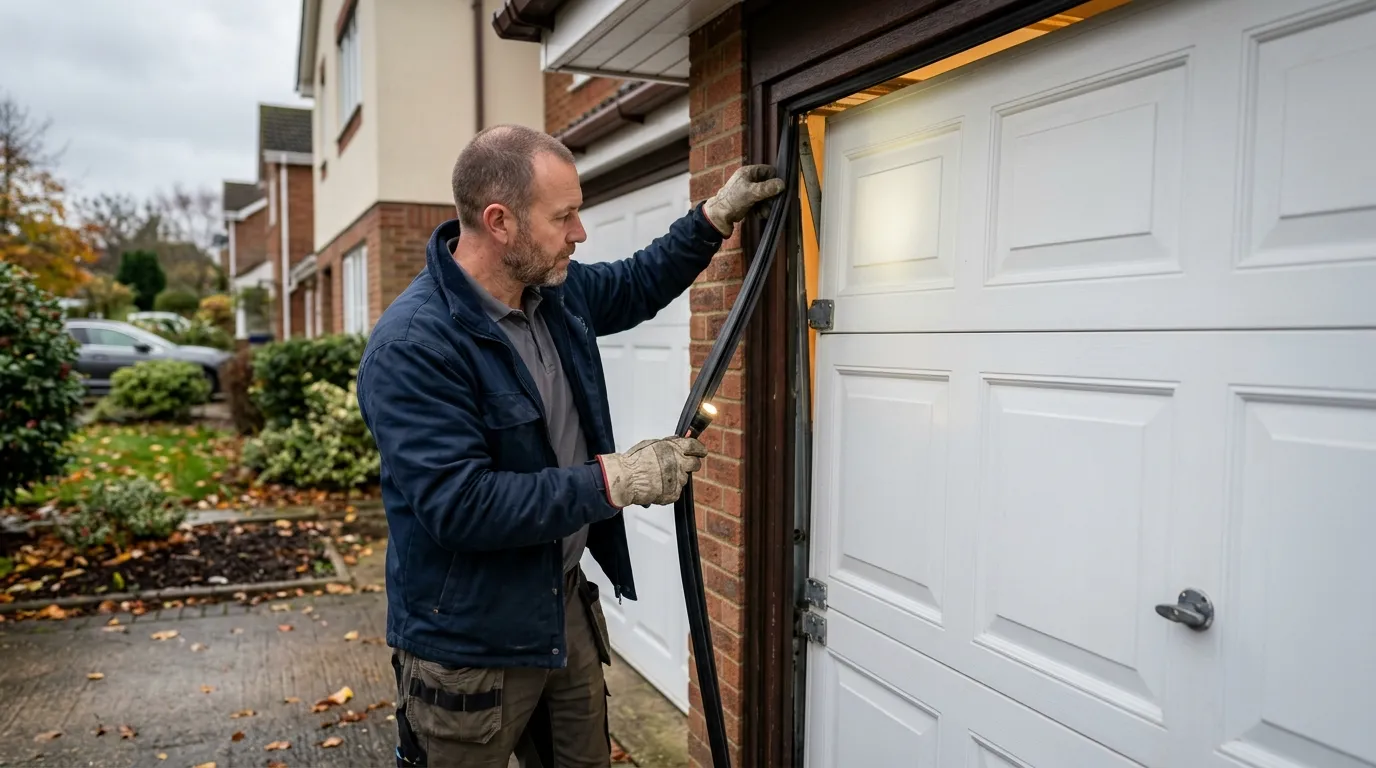
Two sensors sit low on either side of the door track, each one supposed to point straight at the other so the beam between them is unbroken. On a retrofit install - common in homes built well before sensors were required - the bracket is often just screwed into whatever jamb material was there, wood that's now 50 to 80 years old and has shrunk, swollen, and shrunk again through decades of cold-climate winters and humid summers.

Every cycle of that movement nudges the bracket a fraction. The sensor doesn't need to move far - a few degrees is enough for the beam to miss its target, especially in low winter light or with headlights hitting the lens at an angle. Wiring is the other quiet culprit. Older runs stapled along a jamb decades ago get brittle with age and cold, and a hairline break or corroded connection reads to the opener exactly like an obstructed beam: the door won't finish closing, or it closes and kicks back open.

When to Get Help

If the lenses are clean, the small indicator lights on each sensor are solid rather than blinking, and the door still won't close, that's past what a homeowner can fix by re-aiming a bracket by eye. It's a call. Same if the door closes fine some days and not others - that pattern points to a marginal wiring connection, not a dirty lens, and it tends to get worse, not better.

One honest limit: if the bracket itself has rotted out of the jamb wood, common enough in a house pushing 60 or 70 years old, a new sensor won't hold alignment any better than the old one until the mounting surface is solid. Sometimes that means a small wood repair before the sensor work makes sense, and that's worth knowing before you pay for a part swap that won't stick.
How it works

From “it’s stuck” to “it’s fixed”

A quick, honest process - no guesswork and no surprises, start to finish.

  1. 1
    Tell us what’s wrong - Northbrook garage door service

    Tell us what’s wrong

    Describe the symptom - won’t open, loud bang, opener runs but the door won’t move.

  2. 2
    On-site diagnosis - Northbrook garage door service

    On-site diagnosis

    A technician tests the door under power and by hand and finds what actually failed.

  3. 3
    Clear, up-front plan - Northbrook garage door service

    Clear, up-front plan

    You get the fix that’s needed and what drives the cost - before any work starts.

  4. 4
    Repaired & tested - Northbrook garage door service

    Repaired & tested

    The repair is done, the door is set true and tested, and the work area left clean.

Serving Northbrook, IL - tell us what your door’s doing and we’ll take it from there.

How we work

What to expect

  • Diagnosis firstEvery visit starts by finding what actually failed - not a pre-written parts list.
  • The right part for the doorSprings and openers matched to the door’s weight and age, so the fix holds up.
  • Straight answersWhen a repair makes more sense than a replacement - or the reverse - you hear it plainly.
  • Clean, careful workTension released safely, hardware set true, the door tested under power before we leave.
Questions

Frequently asked

Straight answers about garage door repair in Northbrook. Still unsure? Ask us directly.

01Why does my garage door sensor keep going out of alignment?

In older Northbrook homes, sensor brackets are often retrofits screwed into original jamb wood that's shifted over decades of cold winters and humid summers. That slow movement nudges the bracket a few degrees, which is enough to break the beam between the two sensors, even though nothing is actually broken.

02Is a blinking light always a bad sensor?

No. A blinking light on the opener usually means the beam between the two sensors is interrupted, not that a sensor has failed. Dirty lenses, a nudged bracket, or brittle old wiring can all cause the same blinking pattern, so replacing the sensor first isn't always the right fix.

03My door works some days and not others - what's that mean?

Inconsistent behavior usually points to a marginal wire connection rather than the sensor itself, especially in older wiring runs. Cold and humidity swings can make a hairline break act intermittently. It tends to get worse over time rather than resolve on its own.

Ready to get your garage door sorted?

Tell us what it’s doing and where you are in Northbrook - we’ll take it from there.

Request a QuoteCall