How We Get to You
Fox River Grove sits about 20 miles out from our Northbrook shop, further than most of the towns on our route. We still run trucks out here, but a call from Fox River Grove usually gets scheduled rather than squeezed in same-hour the way a closer job might be. That's not a knock on the town, it's just the math of drive time. If your spring goes at 7am, tell the dispatcher where you are so the day gets planned around the miles, not against them. We don't keep a location in Fox River Grove itself, and we won't pretend otherwise - every job here starts with a truck leaving Northbrook. What that means in practice is we ask a few more questions up front (door make, opener brand, whether it's stuck open or stuck shut) so the tech shows up with the right spring size and cable length instead of doubling back. It costs us a little time on the phone. It saves you a second trip charge and a second wasted afternoon.
What That Means for Doors
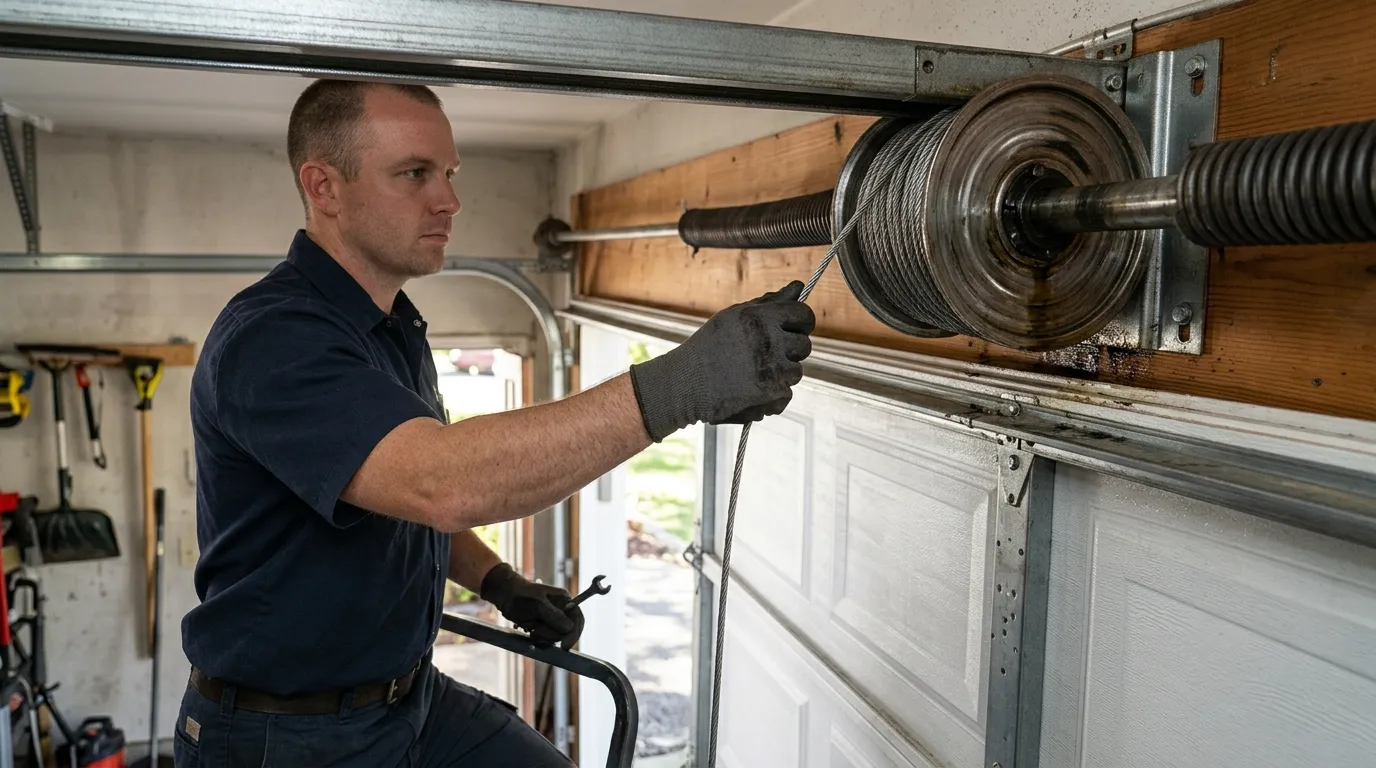
Housing across this stretch generally went up around 1980, a good decade or more newer than the median for the wider service area we work, which centers closer to 1974. That gap matters more than it sounds. A 1980 build is past the era of side-hinge hardware and heavy one-piece wood slabs - you're looking at steel sectional doors on torsion or extension springs, garage door openers with chain or belt drives from a few manufacturer generations back, and standard 7-foot rough openings rather than the odd short openings we see on older stock elsewhere. The failures we expect here run more toward worn rollers, stretched extension springs, and openers with dying logic boards than the rusted-through track and mismatched replacement panels you'll find on a house built in the 1940s or 50s. Parts availability is generally better for this era too - a 1980-vintage torsion spring or a standard opener drive gear is something we're likely to have on the truck, not something we have to special-order and wait on.
What Was Built Here
Median household income in Fox River Grove runs around $125,104, noticeably higher than the roughly $103,561 median across the broader area we cover. That income level, paired with a median build year around 1980, generally lines up with owners who replace an opener or a full door rather than nurse a 40-year-old unit along with baling wire and hope. We see fewer of the jury-rigged fixes - a bungee cord holding a broken spring, a 2x4 wedged under a sagging track - that show up more often on the oldest housing stock in our territory. The winters here are the same cold-climate winters as the rest of what we cover, so insulated steel sectional doors and openers rated for cold-weather operation still make sense, but you're less likely to be dealing with an opener that's simply outlived its parts supply. When replacement does come up, it's more often a choice than a forced call.